Showing posts with label melbourne. Show all posts

09 May 2011

Naked-eye planets

There's been a bit of stuff even in mainstream media about four planets being visible in the morning sky at the moment. I didn't think I had a chance of seeing them, because Melbourne has well and truly turned on winter. However, we were up at 6am this morning for a different reason, and there was one big break in the clouds:
Venus, very bright white;
Mercury, faint but not as faint as I expected up to the right of Venus;
Jupiter, looking faintly yellow and about as bright as Venus;
and Mars, definitely red, just above the tops of the houses.

This has made my week! I can't believe I've now seen Mercury with my own eyes; and it was a seriously beautiful sight as a whole.

08 January 2011

Saturn: oh yes we did


Get up at oh-dark-early, that is (4.45am), to check out Saturn and try to spot the new storm that was spotted a few days ago.

Apparently, it looks like this:
(photo courtesy of galaxypix)

Quite remarkable, no? Anyway, we'd set up last night, so it was painless when we got up, and Saturn was in quite a good position over the house. Sadly, the seeing wasn't fantastic; it came in and out, which made focusing a bit of a pain. The rings were very obvious, and I think I could see the shadow of the rings on the planet (or it might have been a dark cloud band). We looked for ten minutes; J claims he could see a bright spot near the limb, when the seeing came good briefly. We came inside to get away from a couple of annoying mozzies for ten minutes, giving the planet time to revolve a bit and give us a better chance of seeing the storm. The seeing was no better when we went back. Again, J thought he saw the brighter spot once or twice; me, I don't think so. I could imagine that I saw it, but I think it was wishful thinking. Anyway, we were done in by sunrise (!!); Venus was behind a tree so we didn't bother trying to see it through the scope. It was incredibly bright though.

22 December 2010

Transits

We've dragged the telescope out twice in the last week or so, but only briefly. We haven't really had much summer, yet, so it's been quite cloudy and quite cool at night! Anyway, this may be my favourite celestial time of year: Jupiter still visible for a while in the West, and Orion visible at a really decent time in the East. Whee!

Both times we've had a look at Jupiter we've spied shadow transits, which I think is pretty amazing given they were both haphazard viewing opportunities. The first time it was Europa, and tonight it was little Io. Tonight in particular the shadow was a really dark circle on the disc of Jupiter - very obvious indeed.

Also today, the nights officially start getting longer again! Gone are the days when I was just all about the sunshine, baby. Now - ah, now, I get to be totally conflicted. Fun!

16 October 2010

When will I ever sleep?

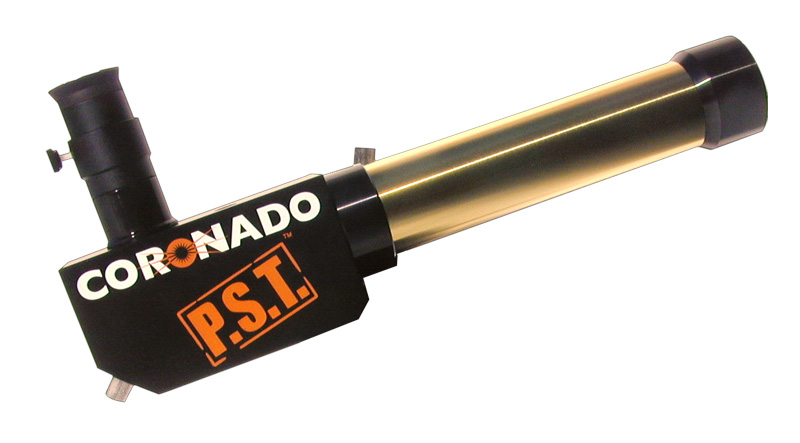
There are a couple of reasons why buying a solar scope at the moment would be silly. In the very short term, it's raining crazycakes at the moment here. In the medium term, we're at solar minimum, so it's not the most interesting time to be viewing.

Um. Yeh.
Photo nicked from Meade website.

Isn't it pretty? The eyepiece it came with is a bit crap, so we swapped in the 10mm when we had a brief break in the clouds, and also had a go with the 6mm.

I looked at the sun! Without my eyeball getting boiled!

We saw three small sunspots. There were two large prominences on the top left limb (I'm not entirely sure which way around the scope is yet), and on the direct opposite limb there were five (maybe six?) small prominences. I saw two... well, they looked like tears on the surface; I'm not entirely up on my nomenclature yet, either. It was very, very cool.

It has occurred to me that getting a PST at this point in the solar cycle is actually excellent. It's interesting right now, and it's only going to get better from here.

But seriously: when will sleep? Observing all day, observing all night... oh yeh, when it's cloudy. And at dawn and dusk.

01 October 2010

An experiment

That's the Lagoon Nebula (M8), from our backyard: iso 800, 30 seconds. Check out that colour!!

A little Jupiter: iso 800, 1/800 second. Bit sad you can't see any moons... longer exposure, and darker skies, required.
The Jewel Box - a lovely little cluster near the Southern Cross: iso 800, 5 seconds. Not quite in focus, but you can still make out some colour.

Cr316: J's favourite little cluster, in Scorpio. Iso 800, 5 seconds.

26 September 2010

Spring apparently means clear nights!

Well, this is Melbourne, so when I say 'clear nights' I really mean 'one clear night amongst the many murky ones.' Nonetheless: today it hit 20C for the first time in many months, there were lovely clear blue skies for most of the day - I sat outside and read! - and it stayed clear for the evening.

We started off looking at Venus, which was a delightful thin crescent. Then, waiting for the sky to darken at least a little, over to Alpha Centauri; split beautifully.

It didn't ever really properly darken tonight; probably we didn't leave it quite late enough. Anyway, Antares (the anti-Ares, ie Mars; cool!) was a lovely reddish colour, and I discovered that beta Scorpius, aka Graffias, is a double: a pair of whiteish-blue stars. Another of the Scorpius stars is also a double, but I did not split it - although it did look quite bulbous, so perhaps I was close.

Close to Scorpius is M7, which I managed to find all by myself - at exactly the same time that J found it through Copernicus, which was quite funny. It's a lovely open cluster, with a nice scatter of stars. Close to it is M6, but I did not manage to find it, which made me a little grumpy. To make up for it J pointed me towards Cr316, which I'd been thinking of finding anyway. It too is an open cluster, but (optically at least) much tighter than M7. Through the 35mm lens, it was quite spectacular.

Testing out just how good my eyes are, and how light the sky was, I next looked at the star G Scorpius, because next to it is a globular cluster, 6441: very faint from here, and you'd just assume it was a smudge if you weren't looking for it. In fact, my next target - M22 - I didn't even see even though I was looking for it. I got - ahem - a little petulant; J had a look to see where I was at... and it was there, in the eyepiece, I just hadn't noticed. Too faint!! - it's another globular cluster.

Really, all of this was a prelude to the main event, which was Jupiter. In order to get the earliest view possible, J decided he needed to do some gardening: bits of a climbing rose were waving about too high. Up a ladder, with secateurs, with only a red headlamp for light... awesome. Anyway, it was a totally classic view of Jupiter tonight. All four Galilean moons lined up, nicely spaced out. Jupiter itself still looking kinda weird with only one dark belt of clouds.

It was a great night's viewing, in all, and not even too cold. Also, not many insects! I'd like to observe in conditions like this all year rounf!

17 September 2010

A cautionary tale

We were outside, last night, at 6.30pm. It was a mostly clear sky, and the moon looked awesome. While I fussed over dinner, J set up the 'scope, and reported that Venus was a lovely crescent - and that the moon was going to look awesome too.

He then came inside, to help me with dinner, because some clouds were scudding over.

Approximately five minutes later came a sound that generally I love, but - 10 seconds after it started - I realised was something of a problem at that particular moment. It was the sound of rain.

Fortunately, J had put the cover over the 'scope's element, because it was a bit dewey. We hurtled outside and frantically brought it in, rather worried that the rain was going to get heavier. It didn't, but it was enough to put a dampener on everything (boom boom), and of course the clouds stayed put, after that.

That, my friends, is one of the perils of observing in Melbourne.

12 September 2010

The moon just never gets old

I hope I never ever get bored by the moon. Because tonight, we took the scope out for all of ten minutes, just too look at the moon, and you know what? It was awesome.

It's still a little crescent at the moment - although not a wafer-thin as it was on Friday, and don't I wish we hadn't been driving to Ballarat that night! Still, it's only a few percent full; Mare Crisium was looking pretty awesome, and the crater Atlas was right on the terminator looking awesome. I love that bit of the moon, maybe because I look at it all the time when the moon is new. I also had a look at Mare Fecunditatis; the southern half of the moon is somewhere I'm really not as familiar with, maybe because it's more chaotic than the north. I got totally lost around the very southern section, so I gave up.

I love the moon. I just love it.

07 September 2010

Clear skies are here again

It's been a while. Tonight, for the first time in a while, we had both clear skies and the energy to do something with them. Here's hoping Melbourne gives more of the same! - after the rain that's forecast for the end of this week, in any case.

Anyway, given the skies and the fact that even when the sun was barely down I had a good view of crescent Venus, I messaged some friends just down the road that they should bring their kids over for a look - I'd been meaning to do so for ages. They promptly arrived with two in tow, the eldest being sensible and staying home, feeling sick. We trooped out the back and had a good look at Venus, and Mars - just a blob these days - and had a chat about planets. Then, because the stars were coming out and they were enthusiastic, J decided to show off and show them the Jewel Box; I met that with Alpha Centauri, which split beautifully and particularly excited the youngest. All of which was very pleasing.

We went back out a few hours later, because it amazingly remained clear. Sagittarius and Scorpio are back to being high in the sky - it's like seeing old friends! It wasn't particularly dark, but J hopped around some clusters in the two - M4, M6, and M7; M20 and M21 - the Triffid, looking pretty awesome even with the light pollution. Right when we thought we were ready to pack it in, J had a last look all round the sky. And there, my friends, at -2.5 mag, was dear old Jupiter! I can't tell you how ridiculously exciting it was to see it hanging there so brilliant. Io, Europa and Callisto were nice and obvious, as was the one dark band of clouds that it has left. J thought he might have caught sight of the Red Spot, but I am unconvinced. I stared at that disk for quite a while before achey eyes drove me inside.

29 July 2010

I Aintn't Dead

Despite the lack of posting, there's nothing wrong with either us or the telescopes! It's just winter, and bad skies, and too much being tired.

We did get out last Friday and observe the very-nearly-full moon for a while, nearly burning our retinas in the process. I knew it was bright - very bright - but it wasn't until I looked away and realised that the yard looked quite different depending on which eye I used that I realised HOW bright! (With the observing eye, the place looked very dark; with the non-observing eye, it looked like all the lights were on.)

I've been running in the morning and noticing that we've had some spectacularly clear mornings, with Jupiter way up high, so we're hoping that we can try and get in some morning observations in the next little while. That requires a bit of jigging with the bike riding and running schedule, but it might be doable....

02 May 2010

Doubles hunter

With my brand-spanking new Double Star Atlas, I can now really and truly have a go at hunting doubles!

Last night was the first in ages that was actually clear. There were some high wispy clouds at sunset that had J panicking, but they went away so we went outside. As well as my Atlas, the other exciting new thing I have is a Cat's Perch! J's been talking about getting a star chair for months, and he ended up ordering two of these - it's so much easier to focus and hold steady when you're sitting down, rather than standing. He'd constructed them last weekend, and sanded them yesterday, so they were ready for a test. And I loved mine: I was observing to the west, so I ended up having the scope very low down and the seat correspondingly so. I could have had it higher, but I think that would have been more annoying.

So, what did we see? I started off with Saturn, of course; and it was lovely. I could definitely see the shadow band under the rings, and I could just see one moon, which was either Rhea or Dione. I then swung around and decided to play around in Canis Major, to see what doubles I could find and whether the Atlas is going to work for me.

Firstly, I'm glad it's spiral-bound. The Atlas has 30 double-page maps, with constellations and doubles and some other features marked. Then, at the back, it has the list that the authors worked from, of which doubles to include: this has the magnitudes and separations of the respective stars. This is very, very useful when you think you've found the right star, but you're not sure you can see a companion, so you need to know whether they're only 8 arc-seconds apart and therefore unlikely to resolve under light-polluted skies (which happened to me), or whether the companion is TWO HUNDRED AND SIXTY FIVE arc-seconds away and therefore could be one of three faint stars you can see (I am annotating the list as I go, with ticks and dates of when observed. This one I also annotated with "srsly?!"). The one problem - and this is only a problem for me, not the book - is that they're in right-ascension order. This has to do with how the stars are mapped, and I am struggling to really get my head around it. (Dumb moment of the night: realising that I was treating the lines of right ascension and declination as if they were straight, rather than curved....) This is something that I will get used to over time. I presume.

Anyway. Canis Major. Start with Sirius; no luck splitting. Move up to Wezen: success! (At least, I presume so; that's the 265" split.) No luck with Adhara (7" split, so not that surprising). Then, on to some harder ones. There's a little group of three along the 'spine' of Canis, two of which are noted as binaries. I hazarded a guess at where they should be, looked in the scope... and didn't think I'd found it. Asked J for some help, tearing him away from his open-cluster hunting, showed him the map... and he found exactly the same thing. I looked at it a bit longer - checked the list at the back - and realised that actually, one was a triplet, and that's what I'd been confused by: the top star in my eyepiece had two very faint stars nearby, which was indeed my triplet! This was also helpful because I now have an idea of what 44" looks like. That was 17CMA; sadly couldn't split pi, so that will have to wait for another night. After that success, I attempted tau-CMA, which is in the open cluster NGC 2362 - which, I didn't realise, is J's favourite little one. And I found it, and I think I saw the double; at 85" separation, in a cluster, it's hard to be positive.

Unfortunately, I didn't have a great end to the night. There's another little group of three, between Sirius and Mirzam, that looked like they should be easy enough to find - two are bright-ish, and they're convenient between those two very bright stars. I got quite frustrated because I just couldn't find them. So J had a go, and swapped in our widest eye-piece. Turns out I was looking in exactly the right place... but I had totally underestimated just how wide the set was. This is another thing I will have to get used to judging. Anyway: I split v-1CMA and v-3CMA (although the latter doesn't appear to be in the master list, which is odd).

The other thing I have to get used to, and adjust my expectations for, is how many things I will manage to see in a night. At the moment, the answer is not that many. J has much more practice with observing, and reading charts, and is not handicapped with a monumentally unspatial brain like me - so he's always going to see more. It's also a lot easier to tell when you've hit a cluster, than when you've hit a double, so he can skip around more easily if he wants to. I think this is something I can deal with... eventually... and as I keep reminding myself, the sky actually will stay basically the same for my entire life. It's not like I'm running out of time to do this.

22 February 2010

Last week's observing

We had a mighty fine time last week! A whole string of clear nights; we took the 'scope out the backyard and decided to work our way around Orion and Canis Major (and a couple of other fine things).

47 Tuc, and it really was beautiful.

In Orion, I checked out Rigel - which it turns out is a double star, and I could indeed see the very faint blue companion star. I also looked at the other three corners of Orion - Betelgeuse, which was really red, and I forget the names of the other two corners. Then there's Eta Orionis, which is really a triple but only the AB pair are visible, and even then very close: they look to be touching. The Trapezium, of course, is glorious; and the nebula of M42, even from the light-polluted backyard, is always a happy-Alex-making sight.

I enjoyed looking around Canis Major. Of course, there's Sirius - almost bright enough to be blinding in the scope. The delightful H3945 is an orange and blue double, pretty widely spaced apart. But even more awesome - and perhaps my new favourite object - is Beta 324: two pairs of doubles, perpendicular to each other. They just look amazing. Then there's M41, an open cluster; c121, another cluster; NGC2362, a tight cluster with a single very bright star in the center (Tau Canis Majoris); and yet another open cluster in NGC2360.

Mars is particularly marvellous at the moment. It's still getting up a little too late for easy casual viewing, but it's getting there. It's far enough north that when we were out and looking, we had to drag Ptolemy through the entire house (the courtyard looks south) to check it out. But it was worth it: a great big red disc. Glorious.

I think that basically covers it. I was pretty out of it the first night, despite J's attempts at jollying me into it. The next few nights I got more into it, which was great.

05 January 2010

Mount and mosquitoes

A little while back J caved, and decided that actually he'd quite like his tripod back, and the telescope would do better on its own, proper, mount. So he ordered one, and six weeks later it finally arrived. Huge darn box for me to lug home from the post office.

There was a bit of angst over the setting up, and we're still not entirely sure it's exactly how it should be. But it's very stable, so it seems ok. And I love that there is a little tray between the legs for putting eye pieces on!

Last night, a lovely evening, we were too stuffed to take advantage of it. Tonight, there are a few clouds around; we went out for a little bit, but were soon driven inside by mozzies. Before that, we had a quick look at Jupiter - very low on the horizon and quite atmosphere-muddled. Then Orion, but really it's not dark enough yet. Finally, because I noticed in Stellarium that they were close to Orion and Sirius and therefore should be easy enough to find, J found the open clusters of M41 and M47. At that point we caved before the might of the insects and decamped inside.

I love the mount, though. It's lovely and wooden, and suits the scope far more than the grey metal of the camera tripod ever did - a very important consideration, of course.

21 December 2009

Back in the saddle...

or on the 'scope, as the case may be.

As my friend Gina noted the other day, the blog has been rather quiet of late. There are a few reasons for that. Firstly, the late Nov/early Dec sky - earlyish in the evening and especially from our yard - is boring as batshit. Second, there have been lots of cloudy nights recently, and when there have been clear nights... well, third, we've been awfully tired.

Anyway: tonight it was beautifully clear, we're not too tired, so I pulled Ptolemy out and there was Jupiter. Looking lovely. I didn't quite get out it in time to see the moon - it had disappeared behind the trellis - but Jupiter had four moons looking lovely.

Then, I turned around, and presto! there was Orion coming up out of the foliage, and despite a dirty big streetlight (grr) it looked good. And there, my friends, there was the Orion Nebula, M42, looking awfully shiny and nice. The Trapezium (four stars that very obviously form a rectangle) looked brilliant, and with averted vision the nebula itself was looking like a lovely butterfly. I was originally looking through the Ethos, then swapped to the TeleVue for a closer look. And it was great.

J played with his new toy, which arrived today: Fujinon 10X70 binocs.

22 November 2009

Can't believe we got to view tonight

... given that the whole day it's been raining, and raining, and raining.

It's the first night for viewing all week, basically - clouds have come in every night - except Thursday, when we had some friends over and showed them a fingernail of moon (first time for all three!) and Jupiter + three moons (also first time!), which was fun.

Tonight, given we're both awfully tired, we just looked at the moon and Jupiter. J decided to have a go at crossing off one of his sketching goals - from the Lunar 100 - the result of which is this:

He's not sure whether he likes it without the square border. What do you think?

It's number 20 on the list. We like lists. I downloaded a list of galaxies to try and view, the other night. One for dark sites I think.

Jupiter was pretty easy to see; it's clear that in a few months it's going to be completely gone from the night skies, at which point I may cry. When I first pulled it up, all four moons were visible, with two very close together and only just separate. I wasn't sure if they were coming or going... until all of a sudden two became one, which answered my question. Stellarium informs me this was Europa and Io, and that if I'd been just a little more patient - or a little less tired - I would have seen them come apart again quite quickly.

17 November 2009

November has boring evening skies

We've had a couple of viewings of Jupiter, but nothing spectacular. Frankly, November is seeming a bit boring here in the bright urban areas. Plus, we've had some cloudy nights.

Tonight J dragged Ptolemy out and played around with the polar alignment, figuring out exactly where celestial south is from our backyard. He also had a look at 47Tuc, which looked quite good despite it being quite bright to the south. I could see a few stars to the left and bottom; not sure if they're in front of the cluster or part of it.

On to Jupiter, and hey! a shadow transit! Very exciting to see. Just three moons, all in a line. Could see a bit of detail on the planet's disk, the pole looked darker and the two main bands certainly had some texture.

We came back inside and sat around for an hour or so, waiting for Orion to make the sky interesting... and then there it was! We could see the Orion Nebula (M42) from our backyard! This is very exciting. Sure it looked better from Ballarat, but that we can see it clearly and with some detail, even with just a cursory glance, is very encouraging. Four stars were obvious in a tight little cluster, in the middle of the nebula. Expect to see M42 get bigger in that tag cloud over the next few months. I'm also looking forward to looking at the other stars of Orion. Interestingly, the nebula filter didn't seem to help that much. Forgot to look for M43, though, I just realised. Oops.

09 November 2009

That's what you get for impulse buys

Seems like a boring time of year as far as the sky in urban Melbourne is concerned; or maybe that's because we're not staying up late enough, so the sky isn't getting dark enough.

Anyway: the impulse buy was the Telrad. Turns out it's not particularly easy to mount on the Sky-90, which is a shame. To set that right, a box turned up today, to receive which I was required to stay home: it contained a Rigel QuickFinder, which is exactly the same idea as a Telrad, just a bit smaller and easier to mount on Ptolemy.

Unbeknownst to me, J also decided to add an Extender-Q to Ptolemy. Essentially this corrects the Sky-90 for looking at the moon and planets, and gives an extra 350mm of focal length. Now, with the zoom, I have 265x max magnification, though it will take a very steady night sky to get to that level. It does make the scope look totally lopsided, but it also made Jupiter HUGE. Which was cool... pity the atmosphere was so whacked, at least partly from the heat.

We decided to play with the Rigel by choosing a couple of Messier objects in Sagittarius to try and find. First we tried to find M70; pretty sure we got the right area, but it must be too dim; M69 was also too dim, and I'm not convinced we got the right area. M54, however: bingo! Right where it should have been - a very faint globular, but definitely there. Then J realised that with Achenar pretty high up, one of his longed-for targets should be visible... and there, lo and behold, was the glory that is the globular cluster of 47 Tuc. This is one of the brightest globular clusters in our sky, and it looked awesome even in our light-polluted backyard.

All up, a good night's viewing.

08 November 2009

Too hot!

It's Melbourne; we complain about the weather almost as much as Brits do. It's compulsory in this town.

Fairly bright to the south even at 9pm, so not a whole lot of interesting viewing. I got in Jupiter, which was looking pretty good - two moons either side close in, two either side further out. A third band, to the north of the disc, was obvious.

J had flaked in bed because of the heat, so I decided just to be impulsive and simply started turning the adjustors. I was doing this with the 6mm eyepiece, so perhaps not the best for just randomly roving the sky, but kind of fun nonetheless. I didn't find anything interesting - except for a couple of quite red stars - but it kept me amused for a few minutes.

A few days ago...


... it was clear enough to have a quick look at Jupiter, but really not much else; there were skating clouds, and a haze that made it even brighter than normal because the lights were reflecting back off. Did I also mention the mosquitoes?

It's weird to notice the sky having moved around since we started on this caper. Where is Scorpio going?? Why isn't it stable??

29 October 2009

Approved


God clearly approves of our new hobby. All afternoon - clouds. I came home early from uni partly because I didn't want to get stormed on. We get out of pilates... and the sky is completely and utterly devoid of cloud.

Of course, we still had to deal with Killer Mosquito Brigades. It's warm enough I could have been outside in a tshirt, but I wasn't; I like my arms without welts.

Moon was lovely: Copernicus is hugely impressive, of course - I love it more every time. My new discovery tonight was Schiller, an elongated crater that looks really bizarre with half of it full of shadow. I also quite liked this crater, even before J drew it:

Jupiter looked pretty normal. Seeing was entirely average from the backyard.