Yeh, so this is late, but anyway... we saw the eclipse! It was a partial here, apparently about 56% at maximum obscuring (wrong word, I know). We set up in the driveway, which was perfect, and we watched from just after first contact (dang, missed the actual start) until it was clear that the moon was receding - and we knew this happened because ta-dah, the sunspots came back! Because yes, it was a nice enough sun to see; two sets of sunspots, I think, and some nice flares on the edges, etc - so it was worth looking at in general, along with the GREAT BIG PACMAN eating the sun. Plus, we got to show off to several people, two of whom were planned and two of whom were walk-bys, and they were totally impressed, which was good. I was having so much fun I fantasised about not going to work and just looking at the sun all day. I would have had to get a hat out, though.
A few days later, we had a family reunion, so we decided to take the solar scope with us there too. Tragically it was a boring sun - two solo sunspots, as far as I could tell; one impressive-ish flare and a few other tiddlers. Of course, no one else there had ever looked at the sun, so simply seeing the sun was exciting in and of itself. Young adults, old adults, and kids all had a look and they really enjoyed it - some coming back for a second or third glimpse.
I love looking at the sun.
Showing posts with label solar. Show all posts
Showing posts with label solar. Show all posts
22 November 2012


07 June 2012
The Transit of Venus
When we were running at 6.30am yesterday, the sky was mostly cloudy and we felt some despair. However, by 8am the sky was largely clear... except in the lower east. By 8.12, the sun had peeked above the clouds, and we got the solar scope set up on the footpath just in time to see first contact at 8.16. Hooray! We proceeded to watch until second contact was made... and then it was time for me to scurry off to school. But that wasn't the last of our observing.
J brought the scope to school and we set it up with some hope for the middle two periods. There were classes lined up to come and look but... it was mostly cloudy. Again. We were sad. Still, we kept it tracking for an hour and a half, and just before lunch we thought to pack up... but there was a break in the clouds, so we decided to be optimists. Which was a good idea, because bang on the lunch bell the sun came out and stayed out for the entirety of lunchtime, and something like 200 students (and a few teachers) came out to have a look at what everyone else described as a little black dot on the red circle. (Me, used to seeing sunspots, thought Venus looked enormous.) It was highly entertaining to hear the jaded turn into the amazed.
The sun stayed out for a while after lunch, so a couple of classes did actually come out and have a look. All in all I felt very pleased with my attempt at introducing more people to the glories of the sun. Maybe it will have inspired a few!
J brought the scope to school and we set it up with some hope for the middle two periods. There were classes lined up to come and look but... it was mostly cloudy. Again. We were sad. Still, we kept it tracking for an hour and a half, and just before lunch we thought to pack up... but there was a break in the clouds, so we decided to be optimists. Which was a good idea, because bang on the lunch bell the sun came out and stayed out for the entirety of lunchtime, and something like 200 students (and a few teachers) came out to have a look at what everyone else described as a little black dot on the red circle. (Me, used to seeing sunspots, thought Venus looked enormous.) It was highly entertaining to hear the jaded turn into the amazed.
The sun stayed out for a while after lunch, so a couple of classes did actually come out and have a look. All in all I felt very pleased with my attempt at introducing more people to the glories of the sun. Maybe it will have inspired a few!
06 March 2011
ASV Messier Night
This weekend we went to the annual Messier Night held by the Astronomical Society of Victoria, at their dark site a bit out of Melbourne. We arrived mid-afternoon; staked out a spot, and set up our enormous (brand new) tent in the camping area. We set up the PST in the observation field; there was another solar scope somewhere else, which I didn't have a look through. We had a number of people come past to have a look, and they were pretty impressed, which was of course gratifying. The sun was looking awesome: one sunspot by itself, and a 'little' clump of solar spots in the other hemisphere. There were some cool prominences going on too, one in particular that was quite feathery. I didn't actually get much of a look, but that's ok. Hopefully the clouds will stay away in Melbourne a bit more, so I can get it out here.
We set up Copernicus and Keppler before having some food; both got some comments from other astronomers out setting up. People were mostly curious about why our lovely 128mm Tak was in the observational field rather than the photographic.
The night itself was well organised. The site is great - a bunkhouse and toilets, and they had a Lions Club out there with food and drinks - and they had a number of people giving short talks about different aspects of astronomy, as well as someone later in the night giving a talk about what was visible. I hadn't expected that there would be so many people for whom this was a completely new experience; the ASV must have advertised the night outside of the Society itself. It was a good idea, I think: I heard someone very excited about being able to borrow one of the ASV's scopes when they got home. As a consequence of this, though, there were a lot of people wanting to have a look through the various telescopes that were set up. Happily, I had no plan for the night other than find Saturn, and use the Argo to go a tour of the Messier objects.
Early on I had a look at the Pleiades - which just never looks good through a scope - and the Hyades, which I like; it forms quite a distinct triangle. I tried to split Procyon on discovering that it was a double (I was trying to figure out the stars on Canis Minor), but the atmosphere was pretty turbulent, and I have no idea what the mags of the stars are. It finally got dark enough that M42 looked awesome, which was of course a delight.
I had a look at a few Messiers - so many of the open clusters are just dull, and I didn't spend much time on them. Saw M78, that lovely little nebula in Orion, with two associated stars. Then Saturn was high enough above the trees to make it worth having a look - at least if it's something new - and I think, over the night, maybe 40 or 50 people had a look at it. There were some people who had never ever looked at a planet through a scope, and they were seriously impressed. It was a lot of fun, actually; I really enjoy helping people appreciate the night sky. Over the rest of the night I also showed some people Omega Centauri and 47Tuc, impressive of course, and then I finished with M42 - of course - and showed a few people that, too, which they all enjoyed.
It didn't get as cold as I had feared, so the freezer suits never made an appearance (happily!). I made it to 1am comfortably, but from there I started to fade, so packed Keppler away and just had a look through Copernicus. Early on I had looked at the Tarantula Nebula through J's new 20mm Nagler, and it looked spectacular; so did 47Tuc, and an amazing planetary nebula with a hole in the middle. Later in the night it was dark enough to see the Horsehead Nebula, and I think this time that I really did see it, which is thrilling. The Flame Nebula was more interesting, though. Also, the Sombrero Galaxy: seriously, seriously cool. The dust lane was clearly visible... it may be one of the most interesting galaxies I've seen, actually. Just before bed we had a look at the Spindle Galaxy - which I didn't look at long enough to see the elongated ends - and the Ghost of Jupiter, which was just mush. Finished on Omega Centuari, which was an adequate substitute for Orion. I guess.
In the tent by around 2am.
04 January 2011
Sun sketch
Carted the PST around the place, and it wasn't until our second last day on proper holidays that we remembered to get it out! J set it up on the double mount we bought for the Losmandy; he set it up fairly early, and I wandered out for a look three times over the day - and it managed to track fairly well for the whole day, too.
I even did a sketch:
 Done at about 2pm, over a few minutes. It's a composite from a couple of different tunings. Most excitingly, as I went from one tuning where some of those sunspots were more obvious back to where I could also see the prominences (on the limb) - that one on the righthand side suddenly appeared!
I even did a sketch:
 Done at about 2pm, over a few minutes. It's a composite from a couple of different tunings. Most excitingly, as I went from one tuning where some of those sunspots were more obvious back to where I could also see the prominences (on the limb) - that one on the righthand side suddenly appeared!
19 October 2010
My first sun sketches


These are my first attempts at sketching the sun.
The prominences are certainly out of proportion. Obviously because I wasn't using black paper, I struggled to convey the lighter areas on the surface; I chose just to represent them as lighter, squiggly lines.
Both were drawn while viewing through my 10mm Ethos, on a PST. The first was done at about 12.15pm today (19 Oct 2010), while the second was at about 5.50pm.
16 October 2010
When will I ever sleep?
There are a couple of reasons why buying a solar scope at the moment would be silly. In the very short term, it's raining crazycakes at the moment here. In the medium term, we're at solar minimum, so it's not the most interesting time to be viewing.
Um. Yeh.
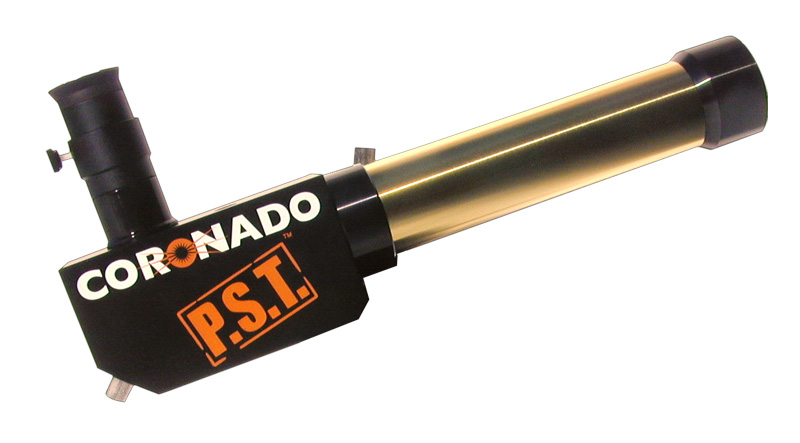 Photo nicked from Meade website.
Isn't it pretty? The eyepiece it came with is a bit crap, so we swapped in the 10mm when we had a brief break in the clouds, and also had a go with the 6mm.
I looked at the sun! Without my eyeball getting boiled!
We saw three small sunspots. There were two large prominences on the top left limb (I'm not entirely sure which way around the scope is yet), and on the direct opposite limb there were five (maybe six?) small prominences. I saw two... well, they looked like tears on the surface; I'm not entirely up on my nomenclature yet, either. It was very, very cool.
It has occurred to me that getting a PST at this point in the solar cycle is actually excellent. It's interesting right now, and it's only going to get better from here.
But seriously: when will sleep? Observing all day, observing all night... oh yeh, when it's cloudy. And at dawn and dusk.
15 October 2010
Lostock: three potential nights of all-out viewing...
Ice in Space Astro Camp: three nights, at a remote Scout camp, with ~100 keen amateur astronomers+hangers-on. What could possibly go wrong?
Friday night: cloudy.
Saturday: the sun was out enough that a dude had his solar scope out, and we wandered over to be bothersome and have a squizz. I saw prominences! And the surface of the sun! Without my eyeball boiling!! ... I might be in love...
For all that it was annoying that we didn't get to observe every night, the camp was awesome. There was a lot of telescope-ogling, and deep discussions about eye pieces. Our cat's perch chairs drew a lot of comment, as did J's scope. The fact that we both have scopes and I wasn't there under sufferance also attracted notice, which I thought was a bit sad; the number of times I basically got asked if I was happy to be there, and then I pointed to my scope and said I got mine first.... There were a few other women there with scopes, but it was by and large a male gathering. It was neat to see a few blokes there with their kids, though, having left mum at home.
Anyway, we did observe on Saturday. Sitting at dinner, we kept sticking our heads out to look at the sky - hopefully noting the holes in the clouds - with the constant refrain being "I've seen it come good from worse...". At one point I realised I could see Jupiter, and I ditched whoever I was talking to and hared it back to our camp. I figured I would at least have a look at it, if nothing else. I caught Venus - lovely little crescent - and Jupiter, and then, all of a sudden, looked up: it was clear! The clouds were almost entirely gone! And wow, the whole camp... changed. Red lights zipping around the place, people excitedly discussing their favourite objects, arguing about collimation: it was cool. We had a little crowd in our area, what with two SDMs next to each other. I got a little frazzled because I couldn't figure out the constellations - I only know Scorpius and Sagittarius in the spring sky! But a couple of people showed me some interesting things, which was really nice of them.
I saw the globulars NGC6388, NGC6397, and NGC6723; BrsO-14 in Corona Australis, a binary with two small white stars; B86 and its accompanying dark nebula - don't think I've ever consciously seen a dark nebula before (the Coalsack doesn't count...); M27 - the Dumbbell Nebula! and possibly Barnard's dwarf galaxy. When I discovered that we could see Pegasus, I checked out the binary that is Matar, which has a bright yellow primary and a faint white secondary. Also through my scope I saw a few other random globular clusters, the Pleiades, M79, and we managed to stay up late enough (bed at 2am!) to see the glory that is Orion (I've missed him!).
Someone set up binoculars near us, through which I finally saw the Andromeda Galaxy. It was... a disappointment, frankly. I couldn't see it naked-eye, probably partly because it just doesn't get that high even in NSW, and through the binos it was just a blob. Still: furthest-away object you can (theoretically!) see naked-eye, and closest galaxy to our own. Nice to cross off the list :)
I also got to have a look through Rod's 20" scope, which he set up next to ours. It required a ladder to get to the eyepiece, and a trailer to bring it to the camp. I saw NGC1365 - a galaxy -which is apparently one of Rod's favourites, and was indeed spectacular. The Saturn Nebula is a weird green colour and does indeed look like Saturn, and 47Tuc was breathtaking. My favourite, though, was being able to see three out of four galaxies known as the Grus Quartet - the other one was just outside the field of view.
All in all, it was a seriously awesome night of viewing, and was a great way to finish the camp.
Subscribe to:
Posts (Atom)